
Planning to Build a WWTP? These BOD & COD Control Factors Determine Whether You Pass Compliance from Day One
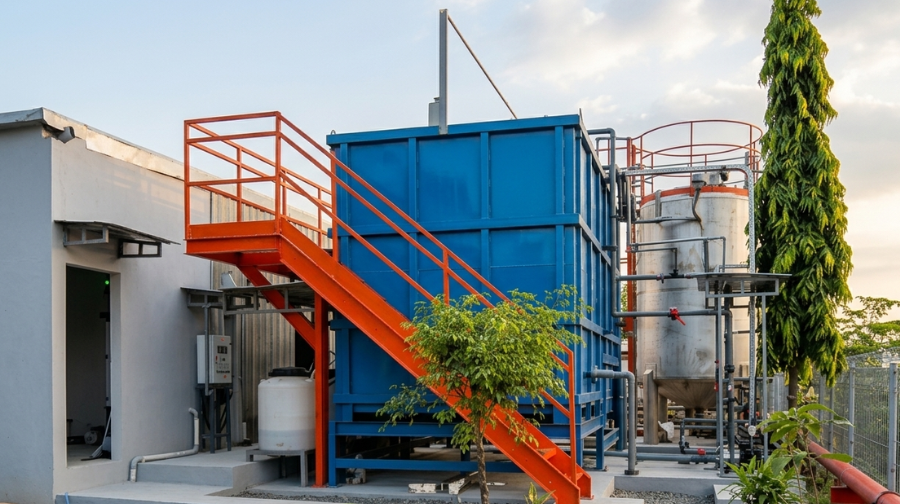
Building a Wastewater Treatment Plant (WWTP) is a major strategic investment for any industrial operation. Unfortunately, many companies run into a harsh reality: a newly built WWTP fails to meet environmental compliance standards on its very first day of operation.
Failing at the commissioning stage doesn’t just trigger legal sanctions and government fines — it can bring the entire production line to a halt.
So what’s the deciding factor between a WWTP that passes and one that doesn’t? The answer lies in the accuracy of your planning and how effectively you control BOD (Biochemical Oxygen Demand) and COD (Chemical Oxygen Demand) from the design stage onward — something our team handles from early-stage planning all the way through to commissioning.
BOD and COD: The Technical Foundation Too Often Skipped at the Planning Stage
BOD and COD aren’t just numbers checked in a post-construction lab test — they should be the basis of your calculations while the WWTP still exists only as a design drawing. BOD measures how much oxygen microorganisms need to biologically break down organic matter in wastewater. COD goes further, measuring every compound that can be chemically oxidized, including compounds microorganisms can’t break down at all.
Even more critical than either number on its own is the BOD/COD ratio of the wastewater your production process will actually generate. This ratio determines which treatment technology needs to be designed in from the start. Wastewater with a high BOD/COD ratio breaks down easily, so conventional biological treatment is enough. A low ratio signals the presence of chemical compounds or dyes that resist biological breakdown — a condition that calls for chemical treatment or advanced oxidation from the design stage, not patched in later once the WWTP is running and lab results keep coming back non-compliant.
What’s at Stake When Your BOD/COD Calculations Are Off at the Design Stage
Environmental permitting drags on. AMDAL, UKL-UPL, and IPLC (wastewater discharge permit) submissions risk delays or rejection for revision if your WWTP design doesn’t align with your sector’s standards and your wastewater’s actual characteristics — pushing back your entire commissioning schedule.
Retrofit costs that were entirely avoidable. Getting capacity or treatment technology wrong at the design stage is far more expensive to fix after construction is complete, especially if the error only surfaces once the facility is already operating and production has to stop for repairs.
Your facility fails compliance from the first day of commissioning. This isn’t a theoretical risk — it’s the direct consequence of a design that didn’t account for your production process’s specific wastewater characteristics.
Reputational risk with investors and business partners. A new project running into environmental compliance trouble right out of the gate raises broader questions about how well the whole project was planned — something investors watch closely, especially on projects under close ESG scrutiny.
Sectors That Need the Most Specific BOD/COD Planning
Every industrial sector has its own wastewater characteristics and compliance thresholds — and these need to factor into your WWTP design from the start, not get adjusted after the fact.
Industrial estates and communal WWTPs need to be designed to handle mixed wastewater from dozens of tenants with different characteristics, with capacity sized for full occupancy — not just the tenants confirmed at the outset.
Textile facilities (weaving, batik, dyeing) will generate wastewater containing dyes that notoriously resist biological breakdown. Without planning for this at the design stage, the wastewater’s BOD/COD ratio will trend low, and standard biological treatment alone won’t hold up once the plant is running at full capacity.
Food and beverage plants have relatively more breathing room, since their organic load — while high — stays largely biodegradable. Even so, they still need equalization tanks planned in to absorb daily production load swings.
Hospitals and healthcare facilities must design in disinfection (chlorination or UV) from the outset — not an optional add-on, but a compliance requirement far stricter than most industrial sectors.
Mining has two very different design needs: coal mines need to plan for pH neutralization from the start because of potential acid mine drainage, while mineral and metal mines need a design that handles a combination of organic parameters and heavy metals at once.
Oil and gas facilities must allocate an Oil Water Separator (OWS) as the first unit in the treatment design — a hard requirement, not something to figure out once construction is already underway.
Every sector above has its own specific compliance standards and regulatory references, and we’ve already mapped them into one ready-to-use design reference table — available inside the free guide at the end of this article.
The Fix Isn’t Always a Complicated System
Here’s the good news: designing the right WWTP from the start doesn’t necessarily mean investing in an expensive or complicated system. The real key is choosing the technology that actually fits your specific wastewater characteristics. For wastewater with a low BOD/COD ratio or compounds that resist biological breakdown — common in textiles, chemical processing, or other complex production lines — an Advanced Oxidation Process (AOP) approach, such as ozonation and H₂O₂, is often far more efficient than forcing a generic biological system that ends up needing patchwork fixes once the WWTP is already running.
We routinely help prospective clients work through this at the early planning stage, before the design and project budget get locked in. Take a look at the range of treatment technologies we offer tailored to your industry’s specific wastewater characteristics.
The Real Root Causes of New WWTPs Failing Compliance (It’s Rarely the Technology Alone)
Based on our experience across a wide range of projects, a new WWTP failing compliance from day one is rarely down to poor technology. It usually comes down to three things getting overlooked at the planning stage:
Capacity gets sized without any growth projection — the design only covers day-one conditions, not the five years of expansion that follow.
A generic design gets built without actually characterizing the wastewater — the technology gets chosen based on general assumptions for the industry, not an actual BOD/COD ratio analysis of the production process that will really run at your facility.
Technical consultation only happens once the facility design is nearly finalized — at that point, there’s very little room left to adjust, and any design change comes at a far higher cost than if it had been planned for from the start.
Where to Start: Make Sure Your WWTP Planning Is Already on the Right Track
All three root causes above are entirely avoidable once you know what to check before your WWTP design gets finalized. And the most decisive first step isn’t about picking a particular technology brand — it’s about how thoroughly you’ve characterized your wastewater and projected your capacity from the very start of planning.
To take the guesswork out of it, we’ve put together a WWTP planning readiness checklist with a full risk scoring system, so you can pinpoint exactly which parts of your project plan still need work before construction begins.
📥 Get the Free BOD & COD Guide
The BOD & COD Guide: How to Design a WWTP That Meets Compliance from Day One
Inside, you’ll get:
✔ A no-jargon breakdown of BOD & COD
✔ Design reference tables for industrial estates, textiles, F&B, healthcare, mining, and oil & gas
✔ A WWTP planning readiness checklist with a risk scoring system
✔ Score interpretation plus technology recommendations tailored to your project plans
Don’t wait until your design is locked in or construction is already underway to find out your facility is at risk of non-compliance. Use this guide now to make sure your WWTP is designed right from day one.
If your self-assessment shows your plans still need work, our technical team is ready to help — from capacity calculations through to BOD/COD control technology recommendations tailored to your project’s needs and budget. Get in touch with our team for a free initial consultation.